How federated analytics enables decision-ready evidence in pharma
Discover how federated analytics helps pharma generate trusted, decision-ready evidence while enabling scalable, privacy-preserving research.


Life sciences companies are under pressure to generate stronger evidence faster across every stage of the product lifecycle. That demand starts long before launch and continues well after, with teams relying on evidence to shape strategy, guide development, support regulatory and payer conversations, and understand how products perform in the real world.
The core issue has moved beyond access to more real-world data. Organizations need evidence readiness: the ability to connect the right data, harmonize it consistently, govern it appropriately, and apply it across decisions. Yet many teams still rely on fixed datasets, one-off studies, and fragmented workflows, making it harder to generate evidence that is timely, consistent, and reusable. As development costs, protocol complexity, regulatory scrutiny, and global data-governance requirements increase, that fragmentation creates avoidable cost, delay, and risk.
Modern evidence generation requires a stronger operating model that connects fit-for-purpose data networks with research-ready data, secure analytics, transparent provenance, and governance that supports both local control and global insight. In the next era, advantage will come less from having the most data and more from assembling the right network around each evidence question, then turning fragmented inputs into decision-ready evidence repeatedly, securely, and at scale.
Evidence readiness also requires a shift in mindset. Rather than treating each study as a standalone data-sourcing exercise, organizations can begin with the decision they need to support and then assemble the data, partners, governance, and analytics environment around that purpose.
More data alone will not solve the problem.
Real-world data only creates value when organizations can turn it into evidence they can trust, use, and reuse.
A reusable evidence foundation is more than a dataset, tool, or study. It gives teams an integrated way to build around a specific evidence need, drawing in the right data sources, partners, sites, geographies, and modalities before turning those inputs into governed, analysis-ready assets that can be reused across multiple studies, teams, and use cases.
This is where a bespoke data network becomes critical. Different evidence questions may require different populations, geographies, data modalities, consent requirements, and analytic approaches, so the operating model needs to be flexible enough to adapt without forcing each team to start from scratch.
As AI and advanced analytics become more embedded in evidence workflows, the underlying foundation matters even more: models are only as reliable as the data, governance, provenance, and context behind them.
| requirement | what it enables |
|---|---|
| Fit-for-purpose evidence design | Starts with the scientific, clinical, regulatory, payer, or commercial decision the evidence must support. |
| Bespoke data network creation | Connects the right data sources, partners, sites, geographies, and modalities around the question at hand. |
| Harmonization and research readiness | Transforms fragmented inputs into comparable, analysis-ready data with consistent definitions and traceability. |
| Governed access and secure analytics | Supports compliant collaboration, federated or hybrid analysis, and controlled use of sensitive data. |
| Use across the product lifecycle | Preserves data assets, methods, governance patterns, and workflows so future questions become faster and more consistent to answer. |
The value of a reusable evidence foundation becomes clearest across the product lifecycle. A single well-designed foundation can support decisions from early opportunity assessment and trial planning through regulatory, payer, medical affairs, and post-launch evidence needs.
Instead of rebuilding data, definitions, governance processes, and analytics workflows for every new question, organizations can carry forward the assets that make evidence generation faster, more efficient, and more defensible. That continuity is especially important for global, multi-modal, and crossfunctional programs where data cannot always move freely, local requirements differ, and stakeholders need comparable outputs they can trust.

Evidence generation now depends on more than access to real-world data. Leading organizations will be those that can turn fragmented inputs into trusted, usable evidence through models that are secure, scalable, and built for reuse.
For life sciences teams, this means making evidence generation less reactive and more repeatable. By moving beyond one-off data sourcing, organizations can build an operating model where data, governance, analytics, and reusable workflows support not only the current study, but the next evidence question as well.
The organizations best positioned to lead will be those that can make evidence generation a repeatable capability rather than a series of disconnected projects. With the right foundation, teams can ask better questions, reach the right data faster, and carry forward what they learn across studies, functions, and markets. The value comes not only from answering one question well, but from making each subsequent evidence question faster, less costly, and more consistent to answer.
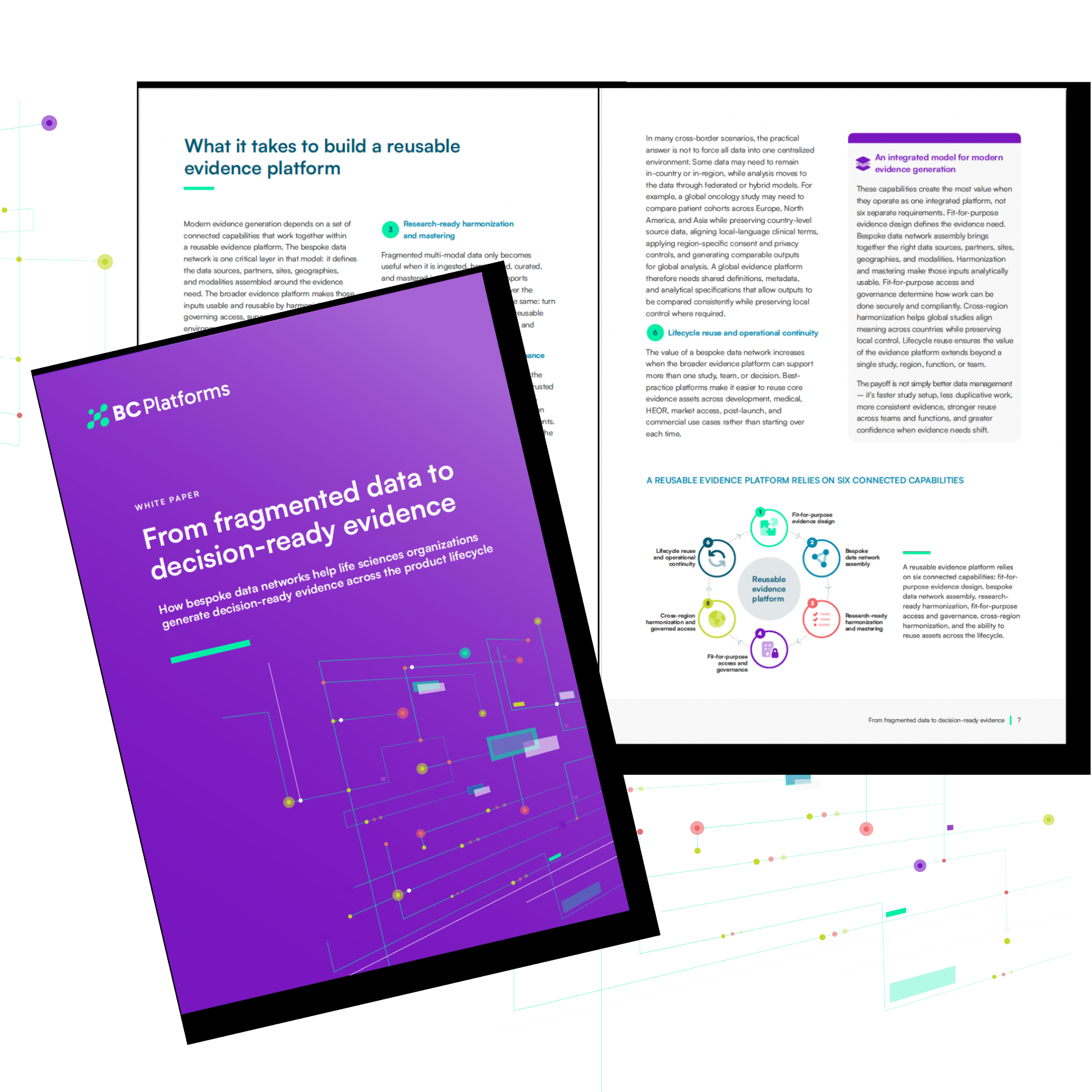
To learn more, read From Fragmented Data to Decision-Ready Evidence to see how to position your organization for the next era of evidence-driven decision-making.
Evidence readiness is the ability to connect, harmonize, govern, and apply data across multiple evidence-generation activities and decision-making processes.
As evidence requirements become more complex, evidence readiness helps organizations generate trusted, reusable evidence more efficiently and consistently across the product lifecycle.
Evidence readiness brings together the data, governance, analytics, and operating models needed to transform fragmented data into trusted, decision-ready evidence.
Evidence readiness depends on fit-for-purpose data networks, research-ready data, governance, secure analytics, and reusable workflows that support evidence generation at scale. For organizations evaluating these capabilities, choosing the right evidence generation platform is an important step.