
How federated analytics enables decision-ready evidence in pharma

Life sciences organizations have access to more healthcare data than ever before, yet many still struggle to generate evidence that is timely, transparent, auditable, and relevant to specific decisions. As evidence requirements expand across the product lifecycle, organizations must transform fragmented, governed healthcare data into trusted, decision-ready evidence while meeting growing expectations around privacy, governance, interoperability, and auditability.
Why pharma needs a new evidence operating model
Today’s organizations often focus on:
- How much data they can access
- How many sources they can connect
- How large a dataset they can acquire
But those questions miss the operational challenge now facing the industry. Life sciences organizations have access to more healthcare data than ever before, yet data abundance is not the same as evidence readiness. Larger datasets do not automatically produce better decisions. Decision-ready evidence depends on context, quality, provenance, governance, and analytical rigor.
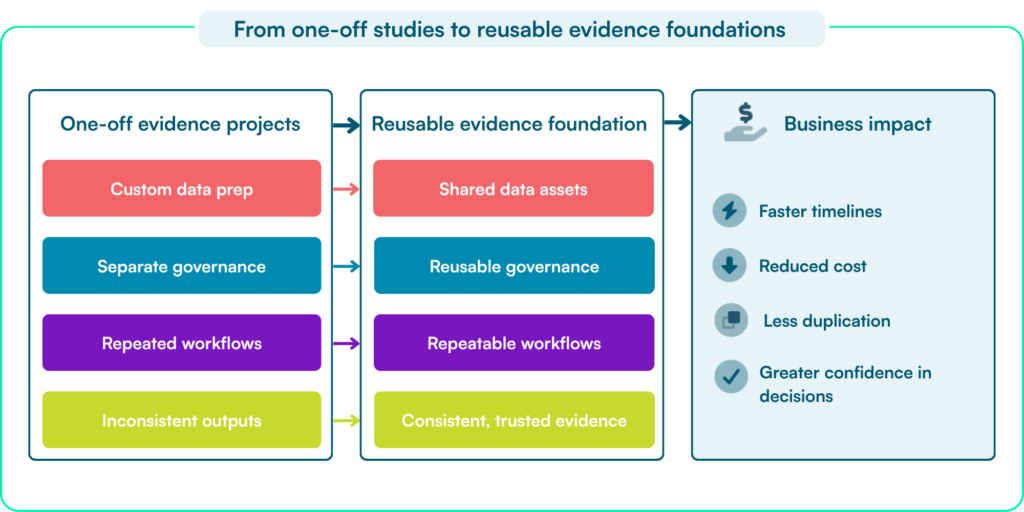
As evidence requirements expand across the product lifecycle, organizations are shifting from collecting data to supporting decisions. That shift requires an operating model capable of applying common analytical methods across distributed, governed data environments. One-off evidence workflows are difficult to scale, often increasing timelines, duplication, costs, and inconsistencies while limiting opportunities for reuse.

The three tensions reshaping evidence generation
For pharma teams, the challenge is not simply finding more data. It is turning fragmented, governed data into evidence that can support decisions across research, clinical development, regulatory strategy, medical affairs, and commercialization. Three tensions are making that harder.
More data is available, but making it usable for evidence is harder
Healthcare data continues to expand across systems, countries, partners, and modalities, creating promising new opportunities for evidence generation. But for pharma teams, access alone is not enough. Data must be findable, permissioned, harmonized, governed, and analyzed consistently before it can support a regulatory, clinical, medical, or commercial decision.
Evidence needs are becoming more specific, but the right data is still fragmented
Organizations increasingly need evidence tailored to specific research, regulatory, clinical, and commercial decisions. Yet the data required to support those decisions often remains distributed across multiple organizations, healthcare systems, and geographies.
Global evidence needs are growing, but data access and governance rules are becoming more complex
As evidence generation becomes more global, organizations must navigate country-specific access rules, privacy requirements, and data-governance expectations while still producing evidence that is transparent, traceable, and trusted. It is not enough to access distributed data; teams also need confidence in how that data was permissioned, analyzed, and transformed into evidence.
Together, these tensions make it harder for pharma teams to generate evidence that is timely, consistent, and decision-ready. Accessing more data is not enough if each study requires custom data preparation, separate governance processes, or new analytical workflows. Organizations need a more scalable way to apply common methods across distributed, governed data environments while preserving trust, transparency, and local control.
Federated analytics as the bridge between data access and evidence generation
Federated analytics offers a different way to work with healthcare data that cannot always be moved, pooled, or centralized. Instead of bringing every dataset into one repository, organizations can apply common analytical methods across governed data environments and compare results across countries, partners, and systems.
This makes federated analytics especially relevant for global studies, multi-country data networks, multi-modal evidence generation, and settings where privacy, data sovereignty, or national governance requirements limit how data can be shared or moved.
In simple terms, analytics travel to the data rather than the other way around. Organizations can answer common research questions across distributed datasets while allowing local partners to retain appropriate control over their data. Researchers can then combine those insights to generate credible, decision-ready evidence across countries, populations, and care settings.
Because healthcare data is inherently distributed across care settings, systems, organizations, and countries, federated analytics gives pharma teams a practical way to generate trusted evidence across diverse, governed real-world data environments.
A framework for building fit-for-purpose evidence
A modern evidence operating model starts with the decision first, then identifies the data, methods, and governance needed to support it. Rather than starting with the data that happens to be available, organizations start with the decision they need to support and build the evidence strategy around that objective.
Building fit-for-purpose evidence requires six interconnected capabilities:


Federated analytics acts as the enabling layer across this framework, allowing common data assets, methods, governance models, and analytical workflows to be reused across teams and decisions. Instead of rebuilding the process for every study, organizations can create a stronger evidence foundation that saves time, reduces duplicated effort, lowers cost, and improves consistency across the product lifecycle.

Putting federated, fit-for-purpose evidence into practice
Designing a federated evidence operating model is one thing. Operationalizing it across geographies, data partners, and healthcare systems is another.
BC Platforms helps organizations put this model into practice by combining global, multi-modal data access, federated and hybrid research models, trusted research environments, data harmonization, and reusable evidence foundations. Together, these capabilities help life sciences teams generate consistent, decision-ready evidence from healthcare data that remains distributed across countries, partners, and systems.
The value extends across the organization. Evidence, clinical, market access, data science, IT, and digital teams all benefit when trusted data assets, methods, governance models, and workflows can be reused — shortening timelines, reducing duplicated effort, improving consistency, and strengthening readiness for AI-enabled evidence generation.
The next five years: evidence generation becomes federated by design
Evidence generation is evolving rapidly. AI-enabled research workflows, multi-modal data integration, and increasing use of real-world evidence in regulatory decision-making are raising expectations around transparency, reproducibility, and scale. At the same time, organizations are moving toward continuous evidence generation and reusable evidence ecosystems that support decisions across the product lifecycle.
As these trends converge, federated analytics will become a core capability for global, privacy-preserving evidence generation. Rather than relying on data centralization, organizations will increasingly bring analytics to governed data environments.
Evidence generation will become:
- More global
- More iterative
- More automated
- More decision-driven
- More federated, with analytics moving to governed data environments instead of relying on data centralization
From fragmented data to decision-ready evidence
More data can create more opportunity, but only if organizations can turn fragmented, governed data into trusted evidence that is consistent, reusable, and ready to support decisions across teams and markets.
Federated analytics, combined with reusable evidence foundations, gives organizations a more scalable way to do that — helping teams generate evidence faster, reduce duplicated work, improve consistency, and create more long-term value from their evidence investments.
The organizations that lead in the next era of evidence generation will not be the ones that simply access the most data. They will be the ones that can generate trusted evidence faster, reuse what they build, and create consistent value from distributed data across decisions, teams, and markets.
Mukhtar Ahmed, CEO, BC Platforms
FAQs
Federated analytics allows organizations to analyze distributed healthcare data without centralizing every dataset. Analytics travel to the data, enabling research across multiple organizations while preserving local governance and control.
Healthcare data is increasingly distributed across countries, healthcare systems, and data partners. Federated analytics helps organizations generate credible, decision-ready evidence while respecting privacy, governance, and data sovereignty requirements.
Fit-for-purpose evidence is designed around the decision being supported rather than the data that happens to be available. It starts with the research question and then identifies the most appropriate data, methods, and governance approach.
In some cases, data can be licensed, pooled, or centralized. But healthcare data is increasingly governed by country-specific privacy rules, institutional policies, data sovereignty requirements, and partner agreements. Federated analytics gives pharma teams another path: applying common methods across distributed data environments while preserving local governance and control.
Reusable evidence foundations preserve data assets, analytical methods, governance frameworks, and workflows so future studies can build on previous work rather than starting from scratch.
Life sciences organizations can prepare by combining federated analytics with reusable evidence foundations: common methods, governed access models, harmonized data assets, and repeatable workflows that help teams generate trusted, decision-ready evidence across studies, markets, and the product lifecycle.