When there’s no registry: Building rare disease evidence that supports regulatory scrutiny
A look at building rare disease evidence across countries and data sources when no established registry or natural history dataset exists.

In a new article published in Pharma Tech Outlook, Mohit Sehgal, Principal Consultant, Technology and Data Services at BC Platforms, explores how life sciences companies can move beyond isolated AI predictions by building trusted, continuous learning systems for drug discovery.
The defining characteristic of an enterprise Lab-in-the-Loop is end-to-end traceability across the scientific lifecycle, connecting data, models, experiments, evidence, decisions, and outcomes.
Mohit Sehgal, Principal Consultant, Technology and Data Services
Drug discovery has traditionally progressed through lengthy and often fragmented cycles of hypothesis generation, experimentation, and refinement. AI can accelerate these cycles by identifying potential targets, designing molecules, generating predictions, prioritizing hypotheses, and uncovering relationships within complex biological data. But computational insights alone do not create medicines. They must be tested experimentally and interpreted by scientists within the appropriate biological context.
Lab-in-the-Loop closes this gap by integrating AI into a continuous cycle of experimentation, evidence generation, and learning. AI systems generate hypotheses or candidates, scientists select the experiments most likely to produce meaningful evidence, and laboratory teams and automated systems execute them. The resulting data informs the next experiment, scientific decision, or model refinement. The objective is not simply to run more experiments, but to learn more from each one. Negative and inconclusive results are therefore as important to the learning process as positive findings. When captured with the same rigor, provenance, and scientific context, they can reveal flawed assumptions, prevent repeated failures, and improve subsequent hypotheses and models.
Organizations are integrating both general-purpose frontier models and specialized biological foundation models into their Lab-in-the-Loop environments. Before applying these models across scientific workflows, life sciences companies must first ground them in, or adapt them using, their proprietary data, experimental evidence, and institutional knowledge. This helps ensure that model outputs reflect the company’s specific biological context, scientific priorities, and accumulated learning. Appropriately grounded or adapted models can then contribute across a growing range of scientific tasks, including knowledge synthesis, biological data analysis, hypothesis generation, protein analysis, molecular design, and property or activity prediction.
Beyond grounding models in their own proprietary data, pharmaceutical companies are also collaborating through federated learning and privacy-preserving platforms to train stronger models without exposing raw internal datasets. In one recent collaboration, AbbVie, Astex Pharmaceuticals, Bristol Myers Squibb, Johnson & Johnson, and Takeda used more than 20,000 proprietary protein–ligand structures to federatively fine-tune the open-source OpenFold3 Preview 2 model, without the underlying structures ever leaving their respective environments.1
Access to broader distributed datasets can strengthen individual models, but no single model—however capable—can address every task across the drug-discovery process. Lab-in-the-Loop environments should therefore incorporate agentic systems that dynamically direct each task to the most appropriate model, tool, dataset, or workflow.
Pharmaceutical companies are increasingly integrating AI with physical experimentation. Eli Lilly and NVIDIA have launched a co-innovation AI lab to create a continuous learning system that tightly connects Lilly’s agentic wet labs with computational dry labs.2 Roche is also using a lab-in-a-loop approach to retrain models with experimental results3.
Recursion Pharmaceuticals, a leading TechBio, has built Recursion OS4, its integrated drug discovery and development platform that combines laboratory automation, large-scale biological experimentation, and machine learning within a continuous learning cycle. Recursion Pharmaceuticals reports running up to two million experiments each week and generating a proprietary dataset exceeding 50 petabytes.
The defining characteristic of an enterprise Lab-in-the-Loop is end-to-end traceability across the scientific lifecycle, connecting data, models, experiments, evidence, decisions, and outcomes.
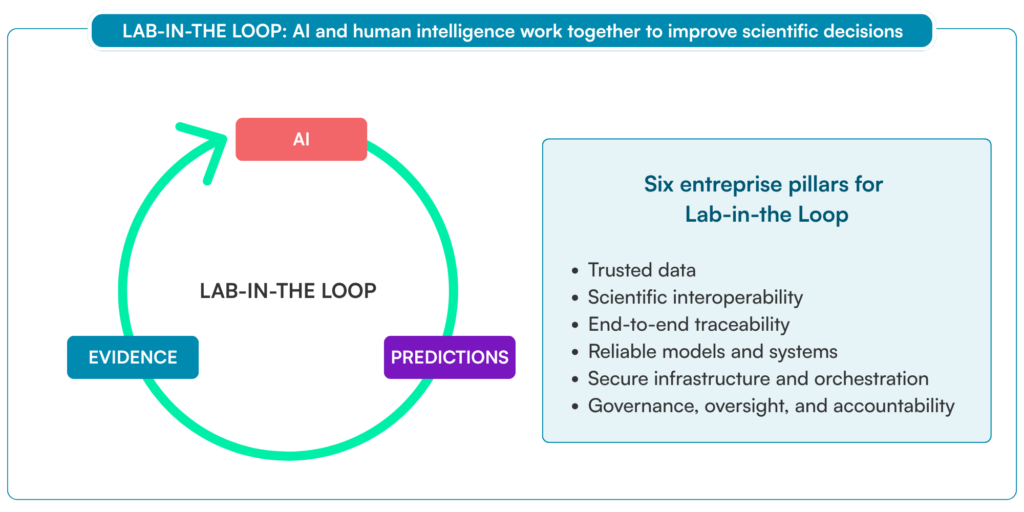
It should operate not as a collection of disconnected AI tools and data platforms, but as an enterprise continuous learning system that turns scientific questions, computational insights, and experimental evidence into better-informed decisions.
This capability requires a common enterprise framework for connecting and governing scientific data, models, instruments, laboratory systems, and workflows across teams and locations, supported by robust governance and a modern operating model. Governed catalogs should manage data, models, protocols, instruments, samples, and workflows as enterprise assets, with clear ownership, versioning, validation status, dependencies, and permitted uses. This enables scientists and AI systems to identify assets that are approved, compatible, and fit for purpose.
Reliable learning also depends on capturing experimental data and metadata directly from instruments and laboratory systems in standardized, machine-readable formats. Common data models, metadata standards, and interoperability protocols are essential to preserve experimental context, connect heterogeneous instruments and platforms, and allow results to flow back into models and workflows without extensive manual transformation.
A shared semantic layer, supported by ontologies and knowledge graphs, preserves scientific meaning and connects diseases, targets, molecules, samples, experiments, models, evidence, and outcomes.
Together, these capabilities provide the control, interoperability, and trust required to scale AI-enabled science across the enterprise.
Technology and scientific leaders should track four dimensions to determine whether the learning loop is becoming faster, more reliable, and more valuable over time.
A recent McKinsey & Company report5 highlights a critical imbalance in AI-driven drug discovery: investment has concentrated on molecule design, where data, tools, and experimental feedback loops are relatively mature. Yet while AI can generate thousands of potential drug candidates, generation alone does not create competitive advantage. The deeper challenge is building a robust therapeutic hypothesis grounded in causal biology by identifying the appropriate disease mechanism, target, biomarker, and patient population.
Addressing this challenge requires connecting laboratory, translational, and clinical evidence across the development lifecycle. This can help research teams continually test their biological assumptions, identify potential causes of failure earlier, and improve the selection of candidates with the strongest prospects for clinical success.
As life sciences organizations integrate AI more deeply into drug discovery, the foundations of a more advanced Lab-in-the-Loop ecosystem are already emerging. Multi-agent AI systems are beginning to plan and coordinate scientific workflows, while laboratory orchestration platforms connect instruments, data systems, robots, and scientists across increasingly automated laboratories.
Physical AI brings intelligence directly into the laboratory by integrating multimodal sensing, AI-based reasoning, and robotic control into closed-loop systems. These setups can perceive experimental conditions, execute appropriate actions, and adapt based on the resulting data. Already, robotic liquid handlers, high-throughput screening systems, and real-time analytical instruments are enabling experiments to be conducted with unprecedented speed, precision, and reproducibility.
Simultaneously, digital twins are emerging at multiple levels—from dynamic virtual representations of biological systems, organoids, and patients to digital replicas of experimental workflows. These twins enable scientists to simulate hypotheses, compare interventions, and identify the most informative experiments before committing valuable samples, reagents, and laboratory capacity.
As these capabilities converge, Lab-in-the-Loop could evolve into a distributed, autonomous scientific ecosystem that seamlessly connects in silico modeling and digital-twin simulation with Physical AI. Such an ecosystem could generate hypotheses, test them virtually, coordinate physical validation across global laboratory networks, and learn collectively from the results in near real time.
Yet as these systems become more autonomous, trust—rather than technology alone—will become the defining requirement. Every hypothesis, simulation, experiment, and automated decision must remain scientifically grounded, traceable, validated, and subject to appropriate human oversight. The future of Lab-in-the-Loop is not a laboratory without scientists, but a trusted ecosystem in which researchers collaborate with AI agents to explore biology at an unprecedented scale. Artificial intelligence will not replace scientific judgment; it will amplify human intelligence, deepen biological understanding, and help bring lifesaving treatments to patients sooner.