The evidence generation trap: 5 questions pharma leaders should ask before building again
Five questions to help pharma leaders stop rebuilding RWE studies and create reusable evidence foundations for the next decision.


The next few years will bring more data, technologies, and research approaches into precision medicine and drug development. Their impact will depend on whether they improve the decisions that determine which therapies move forward, how they are developed, and how they reach patients. Real-world data (RWD) is already informing more choices before and after launch; AI is widening the scope of early-stage research; and hybrid trials, synthetic data and federated approaches are expanding how evidence can be generated. Across each of these developments, the central issue is the same: whether the evidence is strong enough for the decision it is meant to support.
Our new report, The change curve: How far, how fast?, examines ten trends shaping precision medicine, drug development and evidence generation. For each one, it considers where momentum is building, what is slowing progress, and where pharma leaders may need to rethink familiar assumptions. Our analysis looks at what each trend could change in practice and what must be in place for the resulting evidence to stand up to scrutiny.
Across the ten trends, the common requirement is evidence readiness: evidence that can withstand the decision at hand and leave behind data, methods and learning that others can build on. What is sufficient will vary by use case and by the consequences of error. The strategic opportunity is to make those judgments early, then carry trusted work across studies, functions and markets instead of rebuilding the case each time.

The trends are at different stages and raise different questions. Some are already influencing how evidence is planned and used; others still depend on stronger validation, more consistent infrastructure or changes in how organizations work. The table below summarizes what each trend means for drug development and what needs to be in place for it to produce useful, trustworthy evidence.
| The shift underwaY | What it changeS | What will drive impacT |
|---|---|---|
| Real-world data across the product lifecycle | Answers questions about broader populations, longer-term outcomes and routine care that traditional studies may not capture efficiently. | An early, clear view of what the data can and cannot reliably support. |
| Agentic AI moves further into early-stage R&D | Moves the R&D bottleneck from generating hypotheses to validating which ones are scientifically credible and worth pursuing. | Continuous validation, clear controls and scientific oversight. |
| Hybrid trials use RWD to address specific evidence gaps | Reduces recruitment demands and can make studies more relevant to routine care, but raises the burden of proving that the real-world comparison is reliable. | A reliable comparison that justifies the added complexity. |
| Digital twins and synthetic data extend how research questions can be explored | Extends research beyond observed patient outcomes while raising the validation burden as the findings influence higher-stakes decisions. | Validation matched to the intended use and the consequences of error. |
| EHDS creates a route to cross-border European research | Could replace fragmented national access routes with a more workable European research environment — if implementation does not recreate the same barriers country by country. | Consistent access, data preparation and research processes across countries. |
| Interoperability shifts from connected systems to usable information | Reduces the repeated work of interpreting, preparing and validating data each time it enters a new workflow or decision. | Clear responsibility for data quality, workable workflows and fair support for data custodians. |
| RWE planning moves earlier and across the lifecycle | Allows one evidence foundation to support development, regulatory, payer, medical and post-launch questions instead of each function commissioning separate work. | Shared evidence needs agreed before datasets, endpoints and study choices are fixed. |
| Regulatory expectations converge while local differences remain | Shifts effort from rebuilding evidence market by market to planning for portability and adapting where local judgment requires it. | Reusable methods and transparent assumptions, with room for local rules and judgment. |
| Data sovereignty drives federated evidence generation | Expands studies to more countries, care settings and data partners without requiring patient-level data to leave local control. | Comparable data preparation, reproducible execution, traceability and clear ownership at every site. |
| Pharma 4.0 connects digital capabilities to routine decisions | Moves proven data, AI and evidence approaches beyond isolated pilots so they can shape decisions consistently across the business. | Clear ownership, shared governance and workflows that carry proven approaches beyond the pilot. |
Across the ten trends, one conclusion stands out: advantage will come from knowing when evidence is strong enough to act on and building it so the next decision does not start from zero. That judgment will depend on the therapeutic area, the question being asked, the market and the consequences of getting it wrong. A newer approach may be right in one setting, while an established one may be more proportionate and reliable in another. Speed matters only when the evidence can still be defended and the work can be carried forward.
The same capability can therefore be appropriate in one setting and insufficient in another. A dataset may support safety surveillance but not an external control arm. An AI output may help frame a hypothesis but require a very different level of control before it enters scientific or regulated work. Evidence readiness helps teams ask the practical questions early: which decisions need stronger evidence, who is accountable for assessing its suitability and limitations, and what data, methods, and learning can be reused across studies, functions and markets.
For pharma leaders, the opportunity is to connect evidence planning across the business. A fuller view of patients, treatment outcomes and unmet need can strengthen decisions about which therapies to pursue, how to develop them efficiently and how to translate clinical promise into patient access and commercial success. That requires shared data foundations, clear governance, workable processes and accountable owners. When teams can carry trusted data, methods and learning from one decision into the next, they can find evidence gaps earlier, avoid rebuilding work and act with greater confidence.
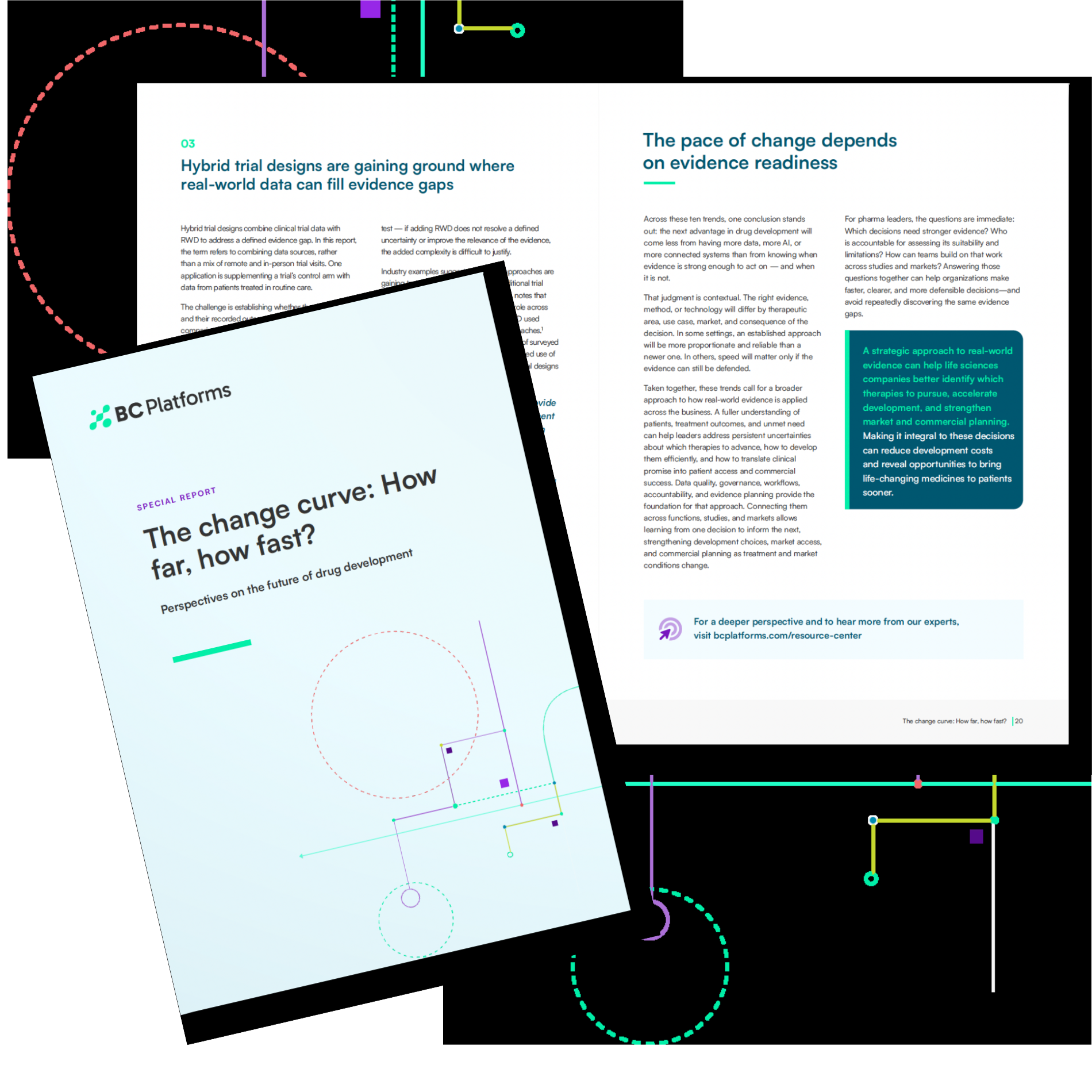
Read the full report for a closer look at the ten trends shaping precision medicine, drug development and evidence generation. Each chapter examines what is changing, why it matters now, what is getting in the way and what pharma leaders should do differently as a result.