A top 20 global pharmaceutical company developing a new therapy needed to understand how a rare autoimmune hematologic disease is managed in real‑world clinical practice. While clinical trial data was available, no global, patient‑level dataset existed to describe treatment patterns, patient pathways, or real‑world outcomes across geographies.
Initially scoped for 150 patients, the study was expanded — based on strong feasibility and site engagement led by BC Platforms — to include 300+ patients across the UK, Europe, the United States, and Japan.
We delivered a harmonized, analysis‑ready dataset combining clinical and laboratory data, accessible through BC Mosaic, our trusted research environment. The sponsor uses the dataset to support internal planning, contextualize clinical trial results, and prepare for regulatory, scientific, and stakeholder discussions, with further use planned for publications and ongoing evidence generation.
Denmark, France, Estonia, Poland, Spain, UK, United States, Japan
Data
Longitudinal clinical data, high‑volume lab data, and patient‑level data captured via eCRFs
Focus
Treatment patterns, treatment changes over time, patient progression, real‑world outcomes, and regional variations
Applications
Internal planning, contextualization of clinical trial results, regulatory and stakeholder discussions, scientific publications, ongoing evidence generation
Design
Multi‑country data collection with phased delivery and harmonization into a single analysis‑ready dataset
Key metrics
8
countries
10
data partners
300+
patients
Background
This rare autoimmune hematologic disease affects approximately one in eight thousand people and currently has no approved therapies.
In the absence of this, patients are treated using a range of therapies based on physician experience. Clinical practice varies widely across countries, and there is limited visibility into how patients are treated in real-world settings.
The sponsor needed to understand:
What treatments patients received
How treatment changed over time
How patients progressed
What outcomes were observed
How these patterns differed across regions
This was required to better interpret clinical trial results and to understand how the therapy would fit within existing clinical practice.
Challenge
No existing dataset
The project started without a usable data foundation — no global registry or dataset captured treatment patterns and outcomes in this disease.
Hard-to-identify patients
Patients were difficult to identify, with data distributed across healthcare institutions and countries. Identifying relevant treatment sites required targeted feasibility and direct outreach.
Heterogeneous data
Understanding the disease required both clinical and lab data. Lab data was critical to providing a comprehensive picture but varied in structure and format across sites, requiring sophisticated processing, harmonization, and integration.
Global coverage essential
A meaningful dataset required 300 patients and needed to reflect variations in clinical practice across the UK, Europe, the United States, and Japan.
Multiple use cases required
The dataset needed to support internal decision-making, publication strategy, and stakeholder discussions, requiring consistent data collection, validation, and traceability.
Solution
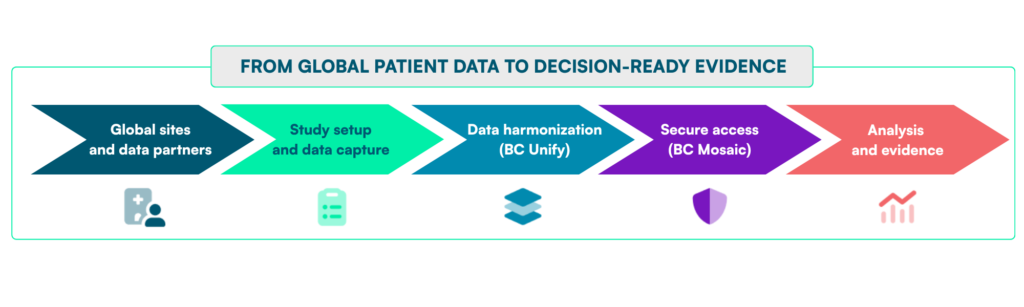
BC Platforms delivered the project through an integrated solution combining global data access, study execution, harmonization, and statistical support. All activities were underpinned by BC Mosaic, our trusted research environment (TRE), enabling both observational and non‑observational studies at scale.
Global feasibility and data partner activation
A structured feasibility process was conducted across BC Platforms’ global data partner network and additional sites, including existing partners, newly identified partners, and sponsor‑nominated centers.
A standardized questionnaire assessed patient availability, data completeness, and site readiness. Based on this assessment, data partners across the UK, Europe, the United States, and Japan were selected.
Study setup and site onboarding
The sponsor developed the study protocol.
BC Platforms supported statistical analysis planning and designed the electronic case report form (eCRF) for data capture.
We also managed data partner contracting and supported site‑level ethics and institutional review processes required for participation.
Data collection and monitoring
Partner sites entered patient‑level data into the eCRF. BC Platforms monitored data collection and conducted onsite monitoring to verify that processes were followed and that data met quality requirements.
Data harmonization
All incoming data was harmonized through BC Unify, our data mastering platform, into a consistent, research‑ready dataset. This included clinical records, high‑volume laboratory data, and patient‑level data captured via eCRFs. Data from multiple sites and geographies was aligned to a common data model, enabling robust cross‑site analysis.
Secure access through BC Mosaic
The dataset was delivered through BC Mosaic, our TRE. The sponsor accessed de‑identified, patient‑level data and began analysis as data became available. Data was delivered in multiple waves to support iterative analysis.
Statistical programming and independent QC
The project scope was expanded to include statistical programming and independent quality control. BC Platforms performed independent programming of analysis datasets, replicated analyses defined in the statistical analysis plan, and validated sponsor‑generated outputs. All analyses were conducted in line with regulatory expectations for submission‑grade evidence, with full traceability and documentation.
This integrated approach enabled the delivery of a high‑quality, harmonized dataset with built‑in validation and regulatory alignment, supporting confident analysis across internal decision‑making and external use cases.
Impact
The project delivered immediate analytical value and longer‑term strategic impact across internal, regulatory, and scientific use cases.
Global view of clinical practice
The sponsor gained a global real‑world dataset and evidence base describing treatment patterns, patient pathways, and outcomes.
This provided additional context alongside clinical trial results and helped explain differences between trial findings and real‑world observations.
Support for internal decision‑making
The data was used in compound‑level discussions across multiple sponsor functions, including clinical development, real‑world evidence, and medical teams. The sponsor highlighted the following a critical elements of these discussions:
Volume of lab data
Number of patients
Depth of the dataset
Quality of the data
Support for regulatory and stakeholder discussions
The dataset supported preparation for regulatory questions and future interactions. It also enabled discussions with physicians and other key stakeholders.
Foundation for scientific publication
The sponsor plans to use the dataset for publications and ongoing scientific communication.
Why BC Platforms
BC Platforms identified and activated sites globally in a disease where no real‑world dataset previously existed, providing access to rare patient populations across multiple geographies. This ability to stand up a global dataset from scratch — in a fragmented, hard‑to‑identify population — was a key factor in enabling the study.
Our flexible data partner model combined existing partners, newly identified sites, and sponsor‑identified treatment centers, allowing the dataset to scale efficiently while maintaining consistency and quality across regions.
We delivered an integrated, end‑to‑end solution, bringing together hard‑to‑find data, seamless ingestion, harmonization, and integration through BC Unify, secure access and collaboration via BC Mosaic, and statistical support from our Scientific Consulting team — ensuring the dataset could be used confidently across internal, regulatory, and scientific applications.
Conclusion
For a rare disease with no approved therapies, BC Platforms built the global real‑world evidence needed to illuminate how patients are treated and support the development of better care options.
By delivering a customized, analysis‑ready, multi‑country dataset with full traceability and secure access, we enabled the sponsor to move forward with greater confidence across regulatory, scientific, and strategic priorities.
Get the clinical evidence you need
Talk to our team about designing and delivering a multi‑country dataset or customize data network tailored to your indication or therapeutic focus.