How federated analytics enables decision-ready evidence in pharma
Discover how federated analytics helps pharma generate trusted, decision-ready evidence while enabling scalable, privacy-preserving research.


Organizations are under pressure to support broader, faster, and more collaborative research while navigating complex privacy, consent, data sovereignty, security, and compliance expectations.
Across the health data ecosystem, institutions with very different missions share the same need for governed access, scalable analytics, output controls, and collaboration across distributed datasets.
That makes it essential to evaluate the TRE decision beyond launch.
Building internally can create value when the environment is central to the institution’s mission, brand, data strategy, partner model, or differentiated research capability. It also requires sustained ownership of security hardening, compliance evidence, access workflows, user support, ongoing enhancements, and governance operations.
Partner-provided TREs can accelerate time to value by reducing the infrastructure lift behind controlled research environments, audit trails, access controls, and continuous updates. But partnership should not mean giving up the decisions that matter most.
Organizations still need to assess total cost of ownership, governance flexibility, data portability, integration options, data residency, exit rights, support model, roadmap dependency, and long-term trust.
The right model depends on the role the TRE plays in the organization’s strategy. Greater internal ownership may be justified when the environment itself is a source of differentiation, such as a branded research program, national data infrastructure, secure AI and analytics environment, or multi-partner evidence network. Partnership is often more effective when the TRE is enabling infrastructure that must work securely and reliably but is not itself the differentiator.
For many organizations, the strongest path will be a hybrid. This approach allows the institution to own the strategy, governance model, data relationships, differentiated workflows, researcher experience, and trust model, while partnering for secure, scalable, federated infrastructure. It keeps strategic control with the organization and reduces the cost, risk, and burden of building every layer from scratch.

| Decision question | What to test | Strategic implication |
|---|---|---|
| Is the TRE itself a differentiator? | Does direct ownership create a clear advantage for the organization’s mission, brand, research network, data strategy, or AI and analytics roadmap? | Increase internal ownership only when control creates strategic value that justifies the long-term operating burden. |
| Can the organization sustain the operating model? | Can internal teams fund, staff, govern, secure, support, audit, and continuously modernize the TRE after launch? | Avoid treating the TRE as a one-time technology project; sustainability, total cost of ownership, and opportunity cost are the real tests. |
| Does collaboration need to scale across sites or partners? | Will the organization need governed analytics across distributed datasets, countries, custodians, or partner environments? | Plan for federation early rather than treating it as a later enhancement. |
| Which capabilities must stay close? | Which decisions define trust, accountability, institutional workflows, data relationships, and researcher experience? | Own the capabilities that create differentiation, accountability, and custodian confidence. |
| Where can partnership reduce burden? | Which infrastructure, compliance, security, federation, and ongoing innovation/enhancements needs require specialist depth? | Partner where proven infrastructure can reduce risk, accelerate time to value, and preserve internal focus. |
Without federation, even well-governed research environments can limit collaboration, data custodian participation, and AI-ready research at scale. Many high-value studies require analysis across datasets that cannot or should not be centralized. A scalable TRE strategy should support governed discovery, queries, analytics, and workflows while preserving custodian control.
This is where the model decision becomes more strategic. A secure single-site environment is challenging; a governed federation layer that scales across institutions is significantly harder. Organizations should assess technical capabilities alongside access approvals, rule enforcement, output review, consent, and data-use obligations.
As research becomes more distributed, trust depends on connected capabilities that support collaboration without weakening local control.
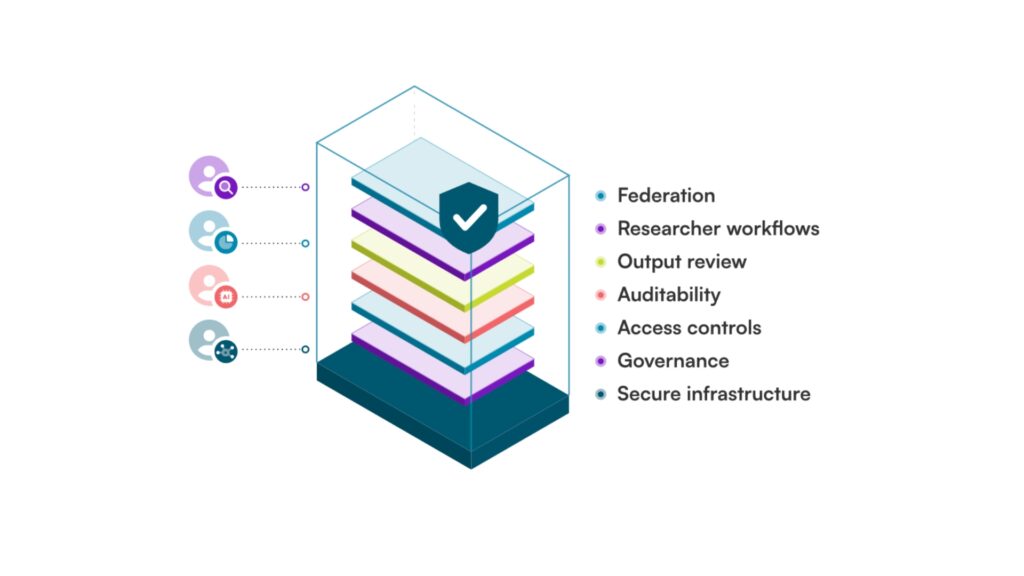
The strongest TRE strategies move beyond the false build-versus-buy binary. They start with mission, risk profile, governance maturity, federation needs, compliance obligations, time-to-value requirements, total cost of ownership, and the ability to sustain trust over time.
Rather than owning every layer, organizations should focus on the decisions that define accountability, differentiation, custodian confidence, and long-term value. For teams planning secure research collaboration at scale, the goal is to choose a model they can sustain, not just launch.
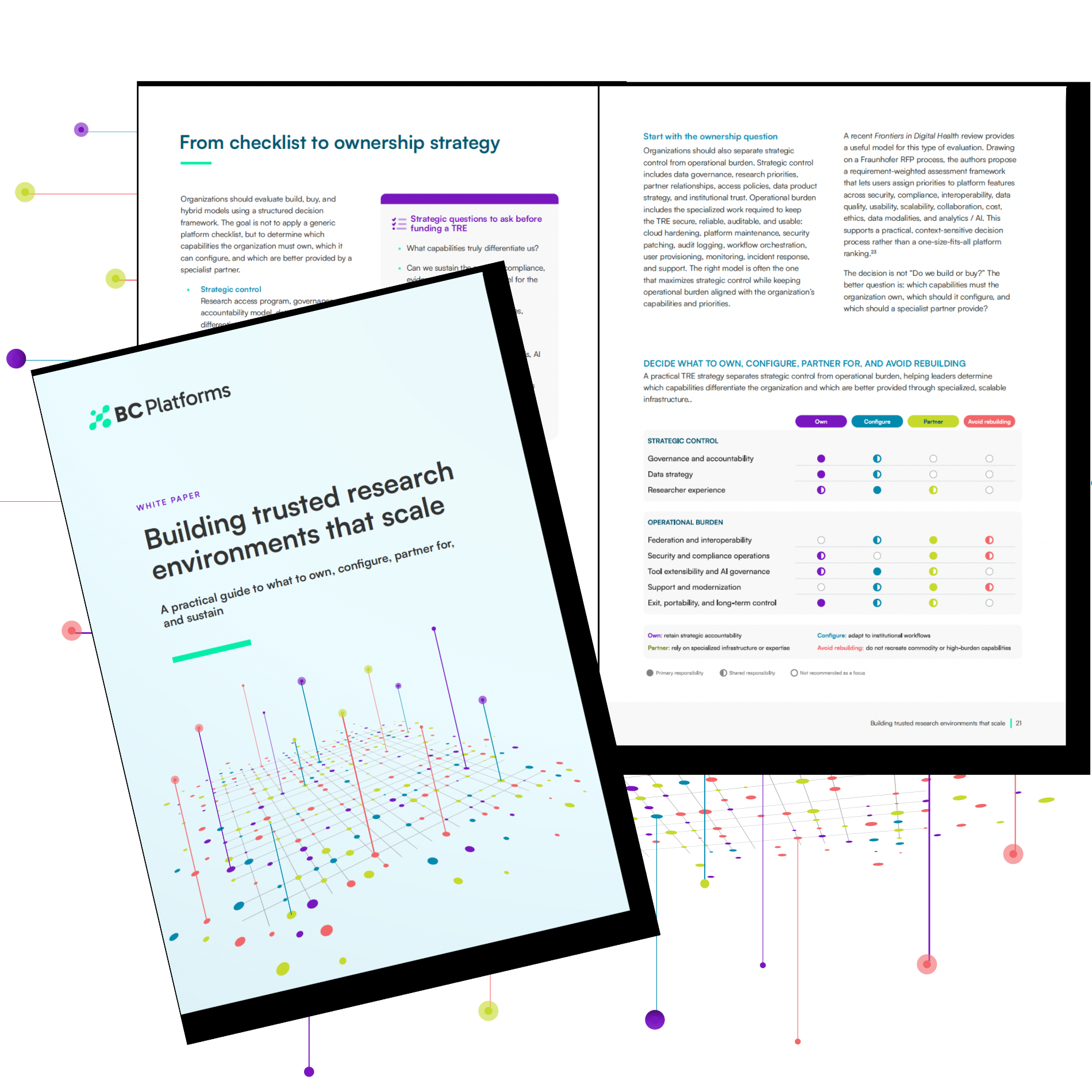
To learn more, read Building Trusted Research Environments That Scale, to help your team make clearer TRE decisions today, while keeping your research environment flexible for the future.