Fit-for-purpose data, decision-ready insights: A conversation with Narasimha Kumar and Tobi Oremulé
Narasimha Kumar and Tobi Oremulé discuss fit-for-purpose data, reusable evidence foundations, and decision-ready evidence.


Federation works when data partners can keep control locally while still contributing to a study everyone can trust. That means agreeing up front who owns data quality, code execution, traceability, and reproducibility across the network.
Narasimha Kumar
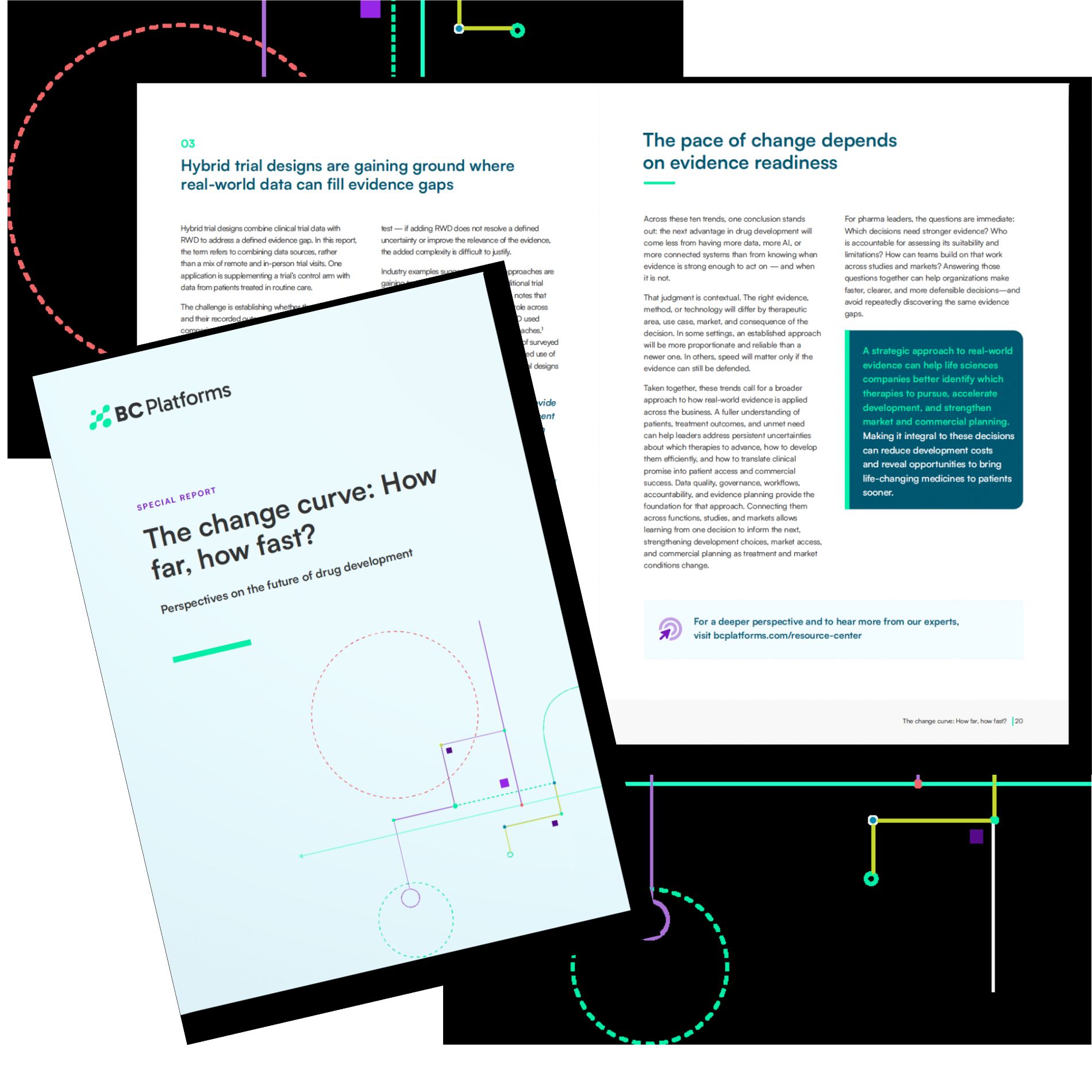
Explore The change curve: How far, how fast? for a closer look at the ten trends shaping precision medicine, drug development and evidence generation.
In simple terms, research tools need to travel to where the data stays, because the data does not travel to a central location. Pharma needs to move from a centralized data collection model to a federated evidence generation model. Instead of transferring patient-level data to a central location, the research questions, analytical methods and algorithms need to travel to the site where the data resides, in a privacy-preserving manner.
That means greater upfront investment in site readiness, data harmonization and common analytical frameworks when pharma designs global evidence studies. It is essentially a mindset shift: from centralizing data to coordinating evidence generation across sites.
The simple answer is to have a common data foundation. We need to implement data quality checks and validate the harmonization pipeline at each site so that the data complies with a common data model and standardized definitions—what we call semantic harmonization.
That is how we make sure the evidence generated across different sites is comparable and trustworthy. There are three aspects: common data models and standardized definitions; standardized analytical methods; and, most importantly, data quality assessments and validation of the harmonization pipeline at each site where the analysis is executed.
Connecting institutions and establishing secure data access and privacy-preserving methods is just a starting point. Connectivity alone does not create a research capability. What creates that capability is common ontologies, standardized analytical workflows and robust data quality processes. These enable repeatable execution of analyses across sites, with results that we can validate, interpret and reproduce within a common semantic framework.
Beyond this, we need a governance framework that works in terms of roles, responsibilities, permissions and approvals. We should not measure a successful federated network by how many institutions it connects or how much data it has, but by how consistently and reliably it generates decision-grade or regulatory-grade evidence across institutions.
At BC Platforms, our focus is on making federated networks research-ready and use-case-driven, rather than simply connecting data sources. We look at three important dimensions: technology solutions designed for future-ready or reusable evidence generation models; a strong network of data partners who understand and are motivated to participate in the evidence generation network; and data and scientific expertise. We do not treat federation as just a connectivity or technology problem. We understand that healthcare data is inherently heterogeneous, so we focus on understanding the data, harmonizing it and improving its quality at source.
To help us do this effectively, we combine BC Mosaic, which is our trusted research environment, with federated analytics. This simplifies the initial build-out and the cumulative value from the evidence generation network.
Finally, we have a strong data partner network where we have already laid the foundations for collaborative research and data asset management. These are the ways BC Platforms’ approach is differentiated and how we apply these principles in practice.
Federated evidence generation brings research questions, analytical methods and algorithms to the sites where patient data resides, rather than transferring patient-level records to a central location. Participating sites coordinate evidence generation using common frameworks while data remains under local control.
Comparability depends on common data models, standardized definitions and analytical methods, and data quality assessments at each site. Validating local harmonization pipelines helps ensure that analyses use data with consistent meaning across the network.
No. Local data control is only the starting point. Research-ready networks also need repeatable analytical workflows, results that can be validated and reproduced, and governance that defines roles, responsibilities, permissions and approvals.
Pharma teams should plan for site readiness, data harmonization and common analytical frameworks upfront. The shift is from collecting data centrally to coordinating consistent evidence generation across participating sites.