BC Catalyst turns fragmented genomic and real-world data into fast, actionable insights through AI-powered, prompt-based exploration.
It gives scientific, clinical, and commercial teams a unified, intuitive way to answer complex research questions in seconds instead of weeks.
The platform accelerates decision-making across the full drug lifecycle, supporting discovery, feasibility, biomarker exploration, treatment outcomes and market uptake, and post-market questions.
Grounded in clinician and domain-expert input, BC Catalyst accelerates evidence generation and advances precision medicine.
BC Catalyst will expand to include additional disease areas, therapeutic domains, geographies and datasets, guided by customer needs.
As a clinician trained in pediatrics and emergency medicine, my work has always centered on understanding patients with the greatest unmet needs. Rare disease communities are one part of that story, but it extends much further. Precision medicine depends on our ability to understand patients at a granular level across diseases, countries, and care pathways. Real-world and genomic data make this possible, yet accessing integrated, high-quality information has historically been difficult. That’s why we launched BC Catalyst, an AI-powered analytics platform built to help researchers explore complex datasets, uncover meaningful patterns, and accelerate decisions across the full drug lifecycle.
Why use BC Catalyst?
Teams across medical, clinical, and commercial functions can use the platform to generate evidence, form hypotheses, evaluate feasibility, or understand how therapies perform in real-world settings, resulting in a more confident, data-driven approach to research, development, and commercialization. BC Catalyst acts as a common language tool, enabling conversations and decisions that were previously difficult. Now, teams can align quickly, make evidence-driven decisions, and reduce late-stage development risks. Ultimately, BC Catalyst will accelerate precision medicine by making real-world data accessible, interpretable, and actionable.
Many data tools fail in practice. What sets BC Catalyst apart?
BC Catalyst offers the ability to see an entire disease area in one place.
First, there is usability. Many data tools are designed by exceptionally skilled engineers yet end up being difficult for people to use, especially if they are not data scientists. Work can feel unintuitive, and outputs are not always generated in a format that people can understand or share quickly. With BC Catalyst, our product team focused on making the experience intuitive for every user. The platform supports AI-based free-text queries and produces clear visual and textual outputs that teams can act on immediately.
Then there is the 360° view. BC Catalyst offers the ability to see an entiredisease area in one place. Instead of jumping between datasets, publications, internal files, real-world data sources, and disparate toolsets, the platform brings everything together and helps you understand how all the pieces connect. This supports the possibilities of precision medicine, allowing collection of the disparate data points from lab-based biomarkers to patient functional factors, that guide management decision. In precision medicine, as well as rare diseases, having a complete and contextual view is key to building the tailored patient profile that will treatment selection.
Finally, there is harmonization. Researchers reviewing RWD sources are often faced with an overwhelming volume of fragmented, incomplete, and siloed multimodal data spanning structured and unstructured pathology, molecular, clinical information, and real-world evidence. BC Catalyst breaks down these silos by bringing together open-source literature, real-world data, and other data from a multitude of sources into an integrated platform. This is a key step towards realizing a fully data-driven approach to accelerating therapies and improving patient outcomes. Understanding the RWD sources available allow us to ask high level feasibility scientific questions to support hypothesis generation, protocol development and early feasibility insights in high quality RWE generation.
A learning system shaped by real-world expertise
BC Catalyst does not rely on static AI models. It learns and improves through continuous input from the people who understand the data best.
Healthcare professionals, including clinicians, are the gatekeepers of real-world data: how it is recorded, stored, accessed, interpreted, and applied. They know which parts of the record are meaningful, which are irrelevant, and how information should come together to reflect the real clinical context.
Because primary healthcare data comes directly from patient care, any secondary use in life sciences comes afterward. Without clinical context, AI can easily miss what matters in practice, from which biomarkers influence decisions to how patients progress through treatment. Clinician involvement ensures that BC Catalyst’s insights remain clinically grounded and relevant to patient care and treatment decisions Alongside clinicians, academics, healthcare scientists and data experts–those with hands-on experience in areas such as genomics histopathology as well as data science–guide how the AI models are trained, validated, and refined. As BC Catalyst expands into new disease areas, integrates new datasets, and grows across geographies and patient populations, their oversight ensures that the platform continues to deliver accurate, interpretable, and relevant insights.
From weeks to seconds: Transforming how scientific questions develop and get answered
With BC Catalyst, I can ask the same question through a prompt and get a clear, data-backed answer in seconds.
When developing a hypothesis, from understanding its relevance in clinical space, to assessing how feasible it is to answer from the real-world landscape, you need answers fast. Where are the treatment gaps, where are the relevant patients? How large are the sub-cohorts? How do they progress? Which biomarkers matter?
Traditionally, pulling these details together means a deep review of existing peer reviewed literature, contacting sites across countries, comparing spreadsheets, and manually checking whether the right level of granularity exists. It can take weeks.
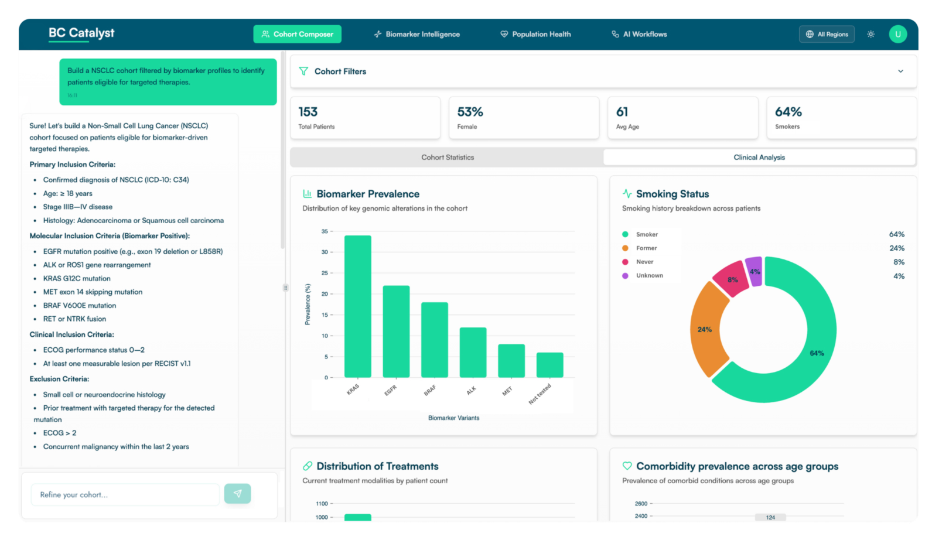
Take a simple example: If someone wanted to explore late-stage lung cancer patients who failed first-line treatment, they would usually spend several weeks liaising with sites in different countries just to estimate how many eligible patients they might have. This may include geographical regions that are unfamiliar to them, such as East Asia. With BC Catalyst, I can ask the same question through a prompt and get a clear, data-backed answer in seconds, that will help utilize resources efficiently for next steps
BC Catalyst brings cohort exploration, biomarker intelligence, and population-level insights into one place. Instead of piecing together information from multiple sources, you can scan the data landscape instantly and move far more quickly toward meaningful scientific decisions.
BC Catalyst allows users to execute prompt-based queries to generate curated knowledge that accelerates speed to insight.
Use cases spanning the full drug lifecycle
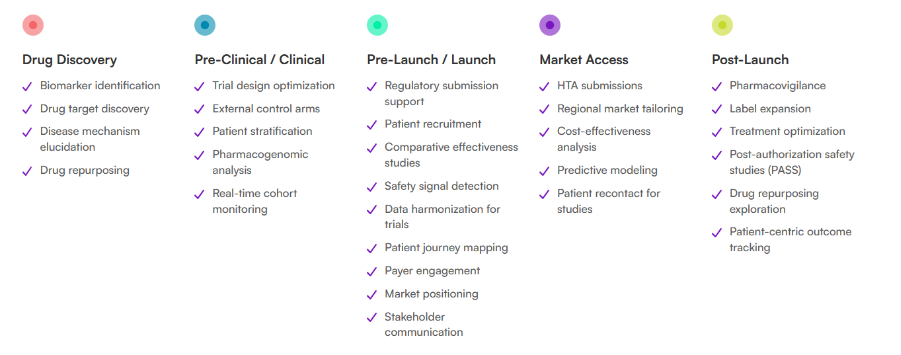
BC Catalyst supports a wide range of use cases across the entire drug lifecycle, from early discovery to post-launch. Research, medical, clinical, and commercial teams can use the platform to understand the research landscape, evaluate biomarkers, explore patient populations, analyze treatment pathways, or understand real-world performance in ways that previously required weeks of manual work.
BC Catalyst offers use cases that span the entire drug lifecycle – from drug discovery to post-launch.
What makes BC Catalyst different?
What might have taken days to weeks can be answered in a couple of free text queries.
A few things stand out more than anything else:
First, high quality data can be found in one place: Molecular, clinical data, real-world evidence, public sources — all unified and enriched through BC Unify, our data mastering engine.
Second, BC Catalyst is easy to use: It has a simple, pharma-grade interface. Natural language prompts. Clear visual and textual outputs. If you can type, you can use it.
Third, it supports across the full drug lifecycle: hypothesis development, discovery, feasibility, biomarker exploration, market insights, post-launch uptake, and more.
Fourth, the scale matters: The platform draws on harmonized patient data from more than 150 partners across 25 countries, plus thousands of public sources. The breadth and diversity of the data fundamentally feed and strengthen the insights.
And finally, the rapid generation: You can build and explore cohorts in seconds, understand biomarker-drug-response patterns, and access standard-of-care insights and custom reporting. What might have taken days to weeks can be answered in a couple of free text queries. BC Catalyst is fast and built to support real scientific decisions, not just generate charts.
Looking ahead: What comes next for BC Catalyst
While our first release centers on select oncology areas, this is only the starting point. BC Catalyst was designed to expand continuously. Upcoming releases will extend into additional oncology indications and then across cardiology, neurology, immunology, and rare diseases. The platform will also grow geographically and demographically, increasing the diversity and depth of the insights it can generate.
This evolution is guided directly by our life science customers. Their questions and research priorities shape where BC Catalyst goes next and which disease areas and datasets we bring in. It is very much a partnership, built around delivering the insights that matter most. I’m excited to see how far we take things – the possibilities seem almost limitless.
Are you struggling to make sense of fragmented, incomplete and siloed data?
Save time, cost, and accelerate your decision-making with BC Catalyst.