Real-world evidence planning: what will the next team need?
What will the next team need from your study? Explore how early evidence planning helps teams reuse suitable data and methods.


New research tools can make some tasks easier while creating new demands elsewhere. A dataset may include the right patients, but do the records track their outcomes for long enough to answer the research question? Similarly, AI can help teams generate hypotheses faster, but turning those ideas into useful findings still takes scientific review and experimental testing.
Real-world data (RWD) can help researchers understand treatments and outcomes in routine care. Analysis of RWD can generate real-world evidence (RWE) about a medical product’s use and potential benefits or risks. However, the data’s usefulness depends on the question. A dataset suited to safety surveillance may not contain the clinical detail needed for an external control arm.
Before committing to a study design, teams need to check whether the data includes the patients, variables and follow-up required to answer their research question. A large dataset is not necessarily a suitable one.
The problem often comes to light too late. By the time a team realizes the data can’t answer the question they’re asking, the study may already be designed, the evidence plan set, and there may be little time left to change course.
Khedidja Hedna, PhD, Senior Pharmacoepidemiologist, BC Platforms
Agentic AI can broaden early-stage exploration, including literature review, hypothesis generation, target identification and experimental planning. As a result, scientists can investigate more possibilities. Biological testing still determines which possibilities hold up.
Faster exploration needs review and experimental capacity from the beginning. Traceable inputs, reproducible methods and scientific oversight must support that work. The consequences of an error should determine the level of scrutiny. Teams also need to revisit those checks when models or intended uses change.
For a research leader, one practical question follows: if exploration becomes faster, can the team assess what comes back?
As AI expands exploration, validation capacity may become the bottleneck. Organizations will need to design the experiments, evidence standards, and review processes that determine what moves forward rather than simply increase the volume of generated possibilities.
The change curve: How far, how fast?
A hybrid trial combines trial data with RWD, rather than mixing remote and in-person visits. For example, teams may supplement a trial control arm with information from patients who received treatment in routine care.
This may ease recruitment pressure, but it moves more of the work into establishing a credible comparison. Teams need to examine patient selection, outcome recording and the comparability of follow-up. Differences between the groups may affect how confidently a team can interpret a result.
Teams need to start with a defined evidence gap. If routine-care data cannot help resolve it, the extra complexity may be hard to justify. Meanwhile, randomized trials remain essential for assessing efficacy. Adding RWD does not remove the need for a defensible design.
Hybrid design should follow the evidence gap, not the appeal of the method. Adding RWD can reduce recruitment demands, but teams still need to demonstrate that the comparison is reliable.
The change curve: How far, how fast?
Digital twins are computational representations of patients, populations or biological systems. They can help researchers simulate and explore what might happen. Synthetic data, by contrast, consists of generated records intended to preserve relevant statistical patterns for selected uses.
This distinction matters when assessing outputs. For a digital twin, the question is whether the representation performs reliably for its intended decision. For synthetic data, teams must assess whether it preserves the properties an analysis needs while protecting individual records.
Here, too, the constraint shifts from generating an output to establishing what it can support. A useful exploratory tool may still be unsuitable for a clinical or regulatory claim. Teams need to agree on the intended use early so they know what to demonstrate before using the output more widely.
Digital twins and synthetic data will advance fastest where the intended claim is clear. A tool used to explore an idea, protect privacy, or support a clinical decision should not face the same test.
The change curve: How far, how fast?
When considering a new capability, ask where it is likely to create more demand. Will the next constraint be data assessment, scientific review, experimental capacity or study-design expertise? Ultimately, making that work visible helps teams decide what to adopt and how to support it.
Making research faster requires organizations to support the work that follows, from checking data suitability to reviewing hypotheses and testing them experimentally.
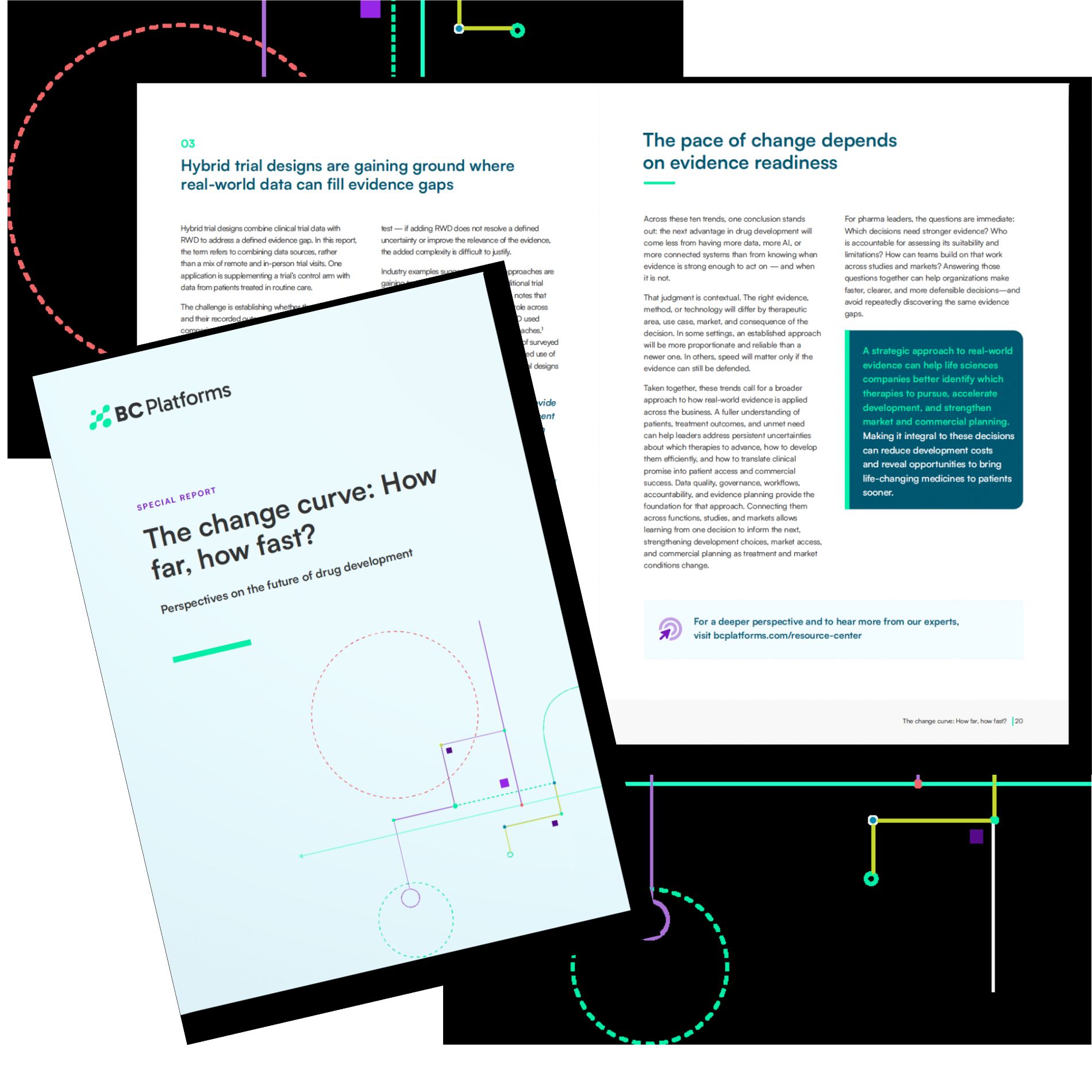
These four themes are part of a wider trend in how researchers study and evaluate medicines. Download The change curve: How far, how fast? Perspectives on the future of drug development for all ten trends.
Real-world data (RWD) is suitable when the relevant patients, variables, clinical detail and follow-up can support the intended research question. A dataset useful for safety surveillance may still be unsuitable for an external control arm. These checks help establish whether the data can support real-world evidence (RWE).
Agentic AI can broaden exploration through literature review, hypothesis generation, target identification and experimental planning. However, research teams still need scientific review and biological testing to establish which outputs are worth pursuing.
In this context, a hybrid trial combines clinical trial data with real-world data (RWD), for example to supplement a control arm. It does not refer to a mix of remote and in-person visits. The added data must support a credible comparison.
No. Digital twins represent patients, populations or biological systems computationally. Synthetic data consists of generated records intended to preserve statistical patterns for selected uses. Each requires assessment against its intended use.