Real-world evidence planning: what will the next team need?
What will the next team need from your study? Explore how early evidence planning helps teams reuse suitable data and methods.


Getting permission to use a dataset is an important moment in a study. However, it can also make a different set of questions urgent. Do the records mean the same thing across sites? Can the team run the analysis consistently? Will the results meet the needs of the intended market?
For teams planning multi-country real-world evidence (RWE), these questions belong together, but they need separate answers. RWE is clinical evidence generated by analyzing real-world data (RWD). The European Health Data Space (EHDS) addresses access, while interoperability addresses shared meaning. Federated research concerns how teams run analyses across locally controlled environments. Regulatory alignment concerns evidence reuse across markets, with room for local requirements and judgment.
Our report, The change curve: How far, how fast?, explores why progress in one area does not establish readiness in the others.
The European Health Data Space offers a route toward more consistent access to health data for approved research across Europe. Its value depends on workable access processes, data preparation, governance and research environments.
Before building a study around broader access, teams need to understand the approvals and research arrangements, including local requirements and implementation conditions.
Permission and practical readiness are different: an approved dataset may still need preparation and analytical work. Planning for both gives research teams and data custodians a clearer view of their commitments.
EHDS should make cross-border studies easier to carry out, not simply make more data accessible. Its value will depend on whether differences in national requirements can be managed without undermining the time and effort that broader access is meant to save.
The change curve: How far, how fast?
Systems may exchange information successfully while recording patients, treatments and outcomes differently. For a study, those differences affect whether researchers can interpret and analyze information together.
Harmonized definitions, documented preparation and confidence in data quality matter as much as the connection itself. In addition, someone has to maintain that work. Data custodians need clear responsibilities, resources and support so participation does not become an open-ended obligation.
Moving data between systems isn’t the same as making it usable. If someone still has to work out what the data really means, if they can trust it, or whether it answers their question, the connection has not solved the problem.
Nathan Smith, VP, Product Technology, BC Platforms
Federated approaches bring analysis into locally controlled environments and return permitted results. Meanwhile, patient-level records remain with the participating data custodians.
This changes where the work happens. Each site needs traceable data preparation, reproducible execution and outputs that teams can assess for comparability. During study planning, teams must establish which analyses can run locally and what results may leave each environment. They must also agree on how to handle differences across sites.
However, keeping records local does not, by itself, guarantee privacy, compliance or reliable evidence. Those outcomes depend on the controls and practices around the study. Similarly, federation is not a requirement for every EHDS study. Access frameworks and analytical architecture answer different questions.
Federation works when data partners can keep control locally while still contributing to a study everyone can trust. That means agreeing up front who owns data quality, code execution, traceability, and reproducibility across the network.
Narasimha Kumar, Global Head of Technology and Data Services, BC Platforms
Common expectations for study quality, transparency and fitness for purpose can make evidence easier to reuse across markets. However, local laws, healthcare systems and evidentiary thresholds can still lead to different assessments.
A common scientific core is therefore useful, provided teams leave room for adaptation. Consistent documentation of methods, data choices and assumptions can help. However, teams still need to check what each market requires for the intended decision.
Agreement on a method does not mean its results are sufficient for every purpose. In practice, separating those judgments helps teams avoid promising more portability than the evidence can support.
Shared scientific principles make data reuse easier, but they don’t make every market the same. The evidence still has to stand up to scrutiny, and teams still need room for local questions, local thresholds, and local judgment.
Susanna Lövdahl, VP Data Operations, BC Platforms
Bring EHDS access, interoperability, federated execution and market requirements into one planning conversation. These are not a mandatory sequence of approvals. Instead, give each requirement an owner and a question to resolve:
Working through these questions early in the process lets partners raise constraints before they become study delays. In addition, it makes each institution’s contribution more visible. That includes preparation and governance work that can be easy to overlook.
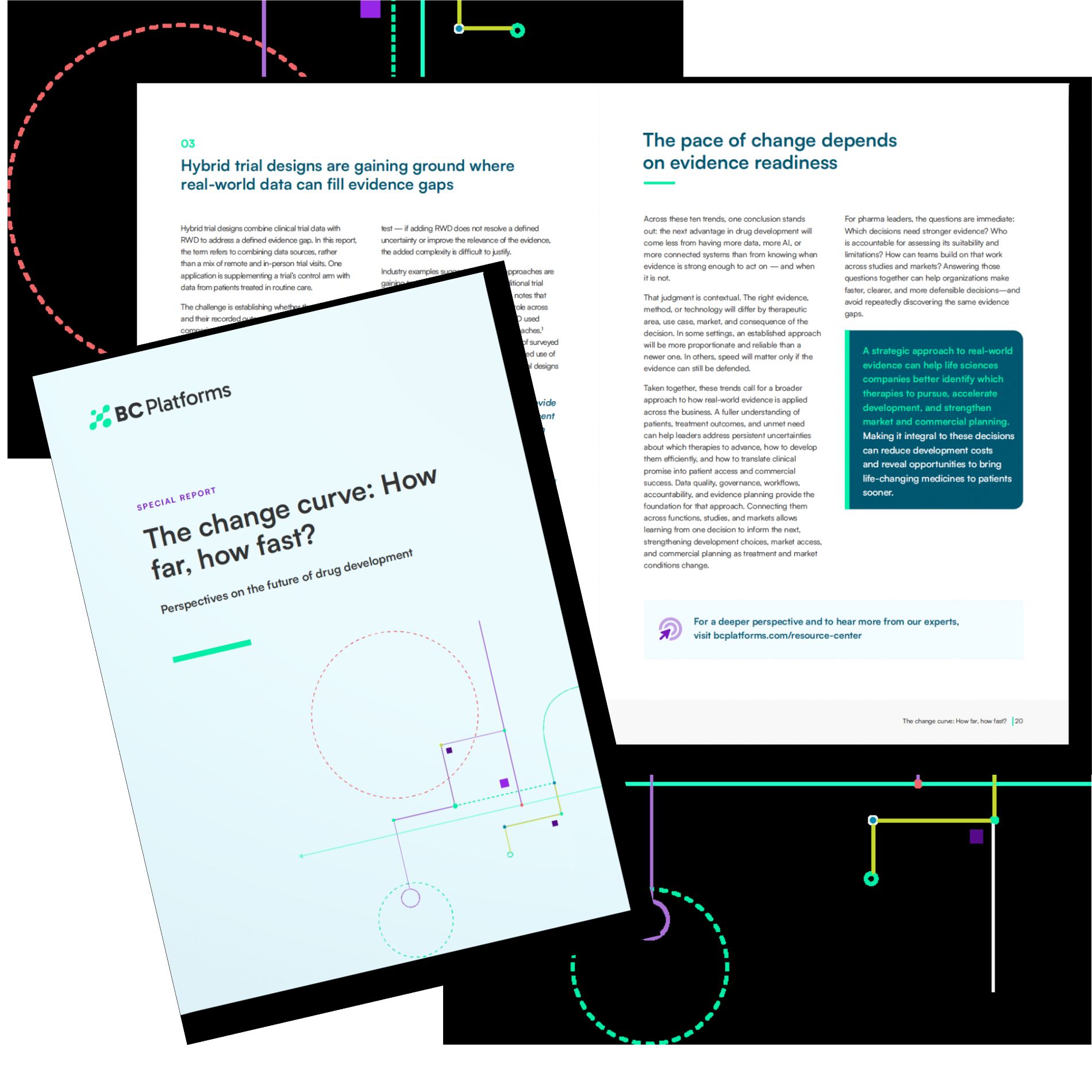
Download The change curve: How far, how fast? for a closer look at multi-country evidence. Explore EHDS, interoperability, federation and regulatory alignment alongside the other trends shaping evidence generation.
The European Health Data Space offers a route toward more consistent access to health data for approved research across Europe. Its practical value depends on implementation, including access processes, preparation, governance and research environments.
Connected systems can still record patients, treatments and outcomes differently. Research teams therefore need shared definitions, documented preparation and confidence in data quality. These help them assess whether they can interpret and analyze information together.
Federated research brings analysis into locally controlled environments and returns permitted results while patient-level records remain with data custodians. Participating sites still need traceable preparation, reproducible execution and comparable outputs.
Common methods and transparent assumptions can support reuse. However, local laws, healthcare systems and evidentiary thresholds may lead to different assessments. Teams must check the evidence against the intended decision in each market.