Multi-country real-world evidence: access is only the first test
Multi-country evidence takes more than data access: align definitions, analysis and market requirements.


As a medicine moves through development and into routine care, different teams need evidence to answer different questions. A study may answer its original question yet leave the next team unable to use its results. For example, a later decision may need a different outcome, a broader patient group or a longer follow-up period. By then, the organization may have to repeat data preparation, extend follow-up or commission a new study.
Real-world evidence (RWE) planning across the drug lifecycle starts with that possibility. Development, regulatory, medical, market access, safety and commercial teams have different questions. Bringing those questions together early therefore helps reveal shared requirements and the need for separate research.
Our report, The change curve: How far, how fast?, examines earlier planning and clearer operational responsibility. It explores how both can help organizations carry useful work from one decision to the next.
Development teams may need to understand differences within a patient population. Meanwhile, medical affairs may focus on comparative outcomes. Market access teams may need evidence of long-term effectiveness and resource use in routine care.
Those questions do not become interchangeable because they involve the same medicine. However, they may draw on the same real-world data (RWD) and share some cohort definitions, outcomes, follow-up and analytical assumptions. Comparing requirements while teams shape the study gives them a chance to identify those overlaps.
Consider an illustrative planning discussion in which a later question needs a longer observation period than the initial study. Before finalizing study choices, the team can assess whether the data and design support both needs. Discovering the gap afterward may mean new preparation, analysis or research.
When teams plan evidence generation in isolation, they risk more than duplicating work. They may discover too late that their real-world data lack the outcomes or length of follow-up needed to answer key questions for regulators, payers, or post-launch decisions.
Keith Collier, Chief Product Officer, BC Platforms
Evidence reuse can mean several things. For example, prepared data, documented definitions and analytical methods may carry forward even when a new question requires fresh analysis. Governance arrangements and established workflows may also provide a useful starting point.
However, the conclusion from an earlier study needs its own assessment. A new population, outcome, market or decision may change what the evidence can support. Reusing the foundations should make that assessment easier, rather than encourage teams to skip it.
Useful documentation explains how teams prepared data and why they chose particular definitions. It also records their assumptions and remaining limitations. As a result, the next team can examine that work instead of reconstructing earlier decisions.
Teams do not need identical evidence questions, but they do need a shared view of where those questions overlap and which data foundations can support more than one decision.
The change curve: How far, how fast?
That continuity depends on more than documentation. It also needs an operating model that gives reusable evidence work a clear owner and a place in routine decision-making.
In the report, Pharma 4.0 addresses this operating-model question: how do teams move from a successful pilot to connected, governed workflows? Others need to know who owns the approach, which decisions it supports and what controls apply.
Give an accountable owner explicit decision rights over what can carry forward, what must change and how the work stays current. Build review and improvement into a governed workflow other teams can follow, rather than treating them as informal extras.
Digital initiatives stall all the time. Usually it’s because ownership was unclear, governance came too late, or the workflow never really changed — not because the technology failed. Pharma 4.0 has to solve for those things from the start.”
Thomas Josse, Data Partner Network Director, BC Platforms
Cross-functional planning does not require every team to agree on one question. However, teams need enough shared understanding to make deliberate choices. Before fixing the design, ask:
Some requirements will be too different to combine. Even so, making that clear early is a useful result. Teams can then plan additional work openly. Otherwise, they risk discovering an evidence gap when a regulatory, payer or post-launch question is already pressing.
Ultimately, the aim is continuity that people can trust. Keep the useful work, understand its limits and recognize when a new question deserves a new study.
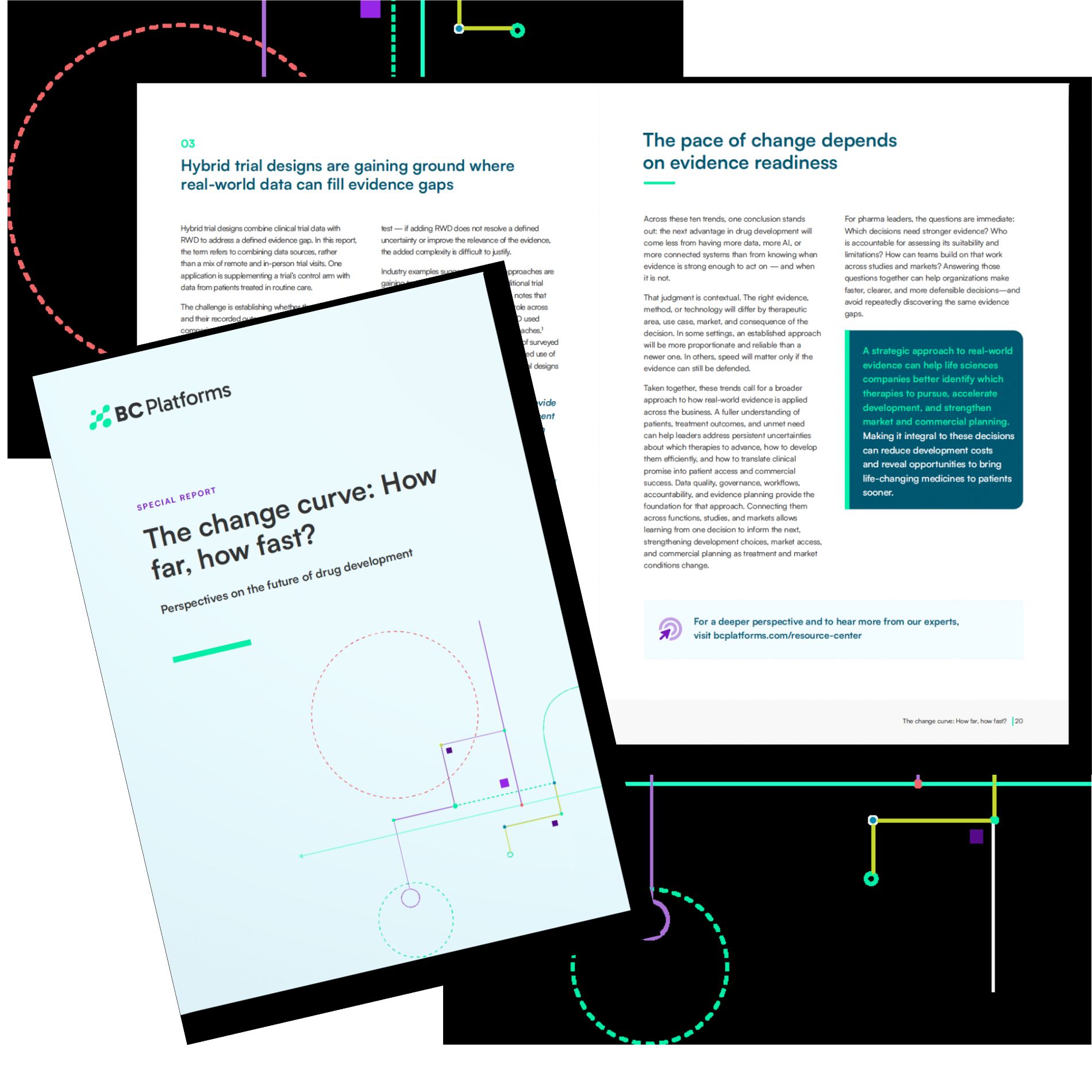
Download The change curve: How far, how fast? Perspectives on the future of drug development for a closer look at lifecycle evidence planning, Pharma 4.0 and the other trends changing how research becomes usable evidence.
Real-world evidence planning across the drug lifecycle brings different teams’ evidence needs into the same early discussion. These include development, regulatory, medical, market access, safety and commercial teams. The aim is to identify overlapping requirements and questions that need separate research.
Planning should begin before teams finalize study designs, datasets, outcomes, follow-up and analytical choices. This gives them time to identify shared requirements, conflicting needs and gaps that may affect later decisions.
Not automatically. Prepared data, definitions, methods and workflows may carry forward. However, teams must assess their suitability for each new question. A different population, outcome, market or decision may require new analysis or research.
In this context, Pharma 4.0 connects digital capabilities with routine, governed workflows. Clear ownership, decision rights and ongoing review help teams assess what can be reused, what must change and how to keep the work current.