Regulatory submissions based on multiple clinical trials are inherently complex—especially in rare, highly specialized indications where patient populations are small and study variability is high.
Success depends not only on generating clinical evidence, but on the ability to interpret heterogeneous datasets, reconcile differences across studies, and present results in a way that meets regulators’ expectations.
BC Platforms supported a biopharma company in preparing a Biologics License Application (BLA) by integrating data across 21 clinical trials, delivering submission-ready datasets, regulatory analyses, and documentation — while taking over critical Phase III activities under compressed timelines.
Data standardization, multi-study integration, and regulatory submission support
Regulatory scope
FDA BLA submission, with prior conditional approval in Europe
Data
Longitudinal clinical trial data, transplant and HLA-related variables, multi-vendor datasets
Use cases
Integrated Summary of Safety (ISS), pooled analyses, Phase III study reporting
Design
Multi-study integrated analysis across 21 clinical trials
Background
A biopharmaceutical company preparing its first therapy for market needed to assemble a regulatory data package for submission to the U.S. Food and Drug Administration (FDA). The therapy, developed for a highly specialized kidney transplant population, had already received conditional approval in Europe, but additional evidence was required for U.S. review.
The submission program was complex from both scientific and operational perspectives. Data had been generated across 21 clinical trials conducted by multiple partners, resulting in differences in structure, format, terminology, and documentation. The datasets also included specialized transplant and Human Leukocyte Antigen (HLA)-related variables that required careful interpretation before they could be standardized and integrated for regulatory use.
BC Platforms was engaged to prepare integrated analyses, combined datasets, and submission-ready documentation for the Biologics License Application (BLA). When concerns emerged around delivery of the pivotal Phase III study, the team also took over critical biocomputing activities under compressed timelines.
Challenge
At a critical stage in the submission, the client lost confidence in the incumbent vendor’s ability to deliver the required analyses with sufficient quality and within the expected timelines. BC Platforms was brought in to take over Phase III study analytics — essential to the submission — under compressed timelines, while continuing broader delivery across the program.
Preparing a company-defining submission
The submission was a high-stakes milestone. It was the company’s first product expected to reach the market and a first-in-class therapy, making the FDA submission critical to both regulatory approval and overall business trajectory. There was significant pressure to keep the submission on track and meet investors’ expectations.
Integrating non-standardized data across 21 studies
The development program included 21 clinical trials conducted by multiple vendors and partners. As a result, data was delivered in different formats, structures, and standards, with inconsistencies in terminology and documentation across studies. Before any integrated analysis could begin, these datasets needed to be aligned into a common framework suitable for regulatory submission. This required a clear strategy for standardization, as well as detailed reconciliation of differences across studies and sources.
Interpreting complex transplant and HLA-related data
The datasets included highly specialized transplant and HLA-related variables that were difficult to interpret and not consistently defined across vendors. Understanding what each variable represented, identifying equivalences between datasets, and determining which data points were relevant to the research questions required deep data science expertise. This work involved detailed analysis of each dataset, direct exchanges with data providers to clarify definitions, and close collaboration with the client’s clinical team to ensure the data could be used appropriately in the submission.
Delivering under rescue-level timelines
The timeline added a further level of complexity. Work of this type would typically begin 12 months ahead of the Phase III study readout. However, BC Platforms took over biocomputing delivery for the pivotal Phase III study only three months before database lock. Taking over at this stage required rapid assumption of responsibility for critical analyses under compressed timelines while ensuring alignment with the broader submission program.
Having already supported the broader submission, we were able to take over Phase III delivery with continuity and speed, enabling our client to stabilize execution and keep the submission on track under tight timelines.
Solution
We took over Phase III study delivery at a late stage, assuming responsibility for clinical study report analyses, CDISC-compliant datasets, and supporting submission documentation — while continuing the broader integration work across the full program.
Filling critical capability gaps
The client lacked internal biostatistics and biocomputing capabilities required for this type of submission. BC Platforms provided combined statistical, data, and regulatory expertise to support both execution and decision-making. Consultants guided decisions on dataset structure, analysis design, submission formats, and required documentation, while ensuring execution remained aligned with regulatory expectations.
Defining a clear path to submission
Consultants worked with our client’s clinical team to define how data from 21 trials would be combined, analyzed, and presented within a single regulatory package. This included development of the Statistical Analysis Plan (SAP), definition of populations and endpoints, and alignment of outputs to support the submission strategy.
Standardizing heterogeneous datasets
A Study Data Standardization Plan was designed and implemented to align datasets from multiple vendors into a consistent, submission-ready format. This involved dataset-level processing, including variable remapping, reconciliation of structural differences, and direct engagement with data providers to resolve inconsistencies. Transplant and HLA-related variables required detailed manual interpretation.
Delivering submission-ready data and outputs
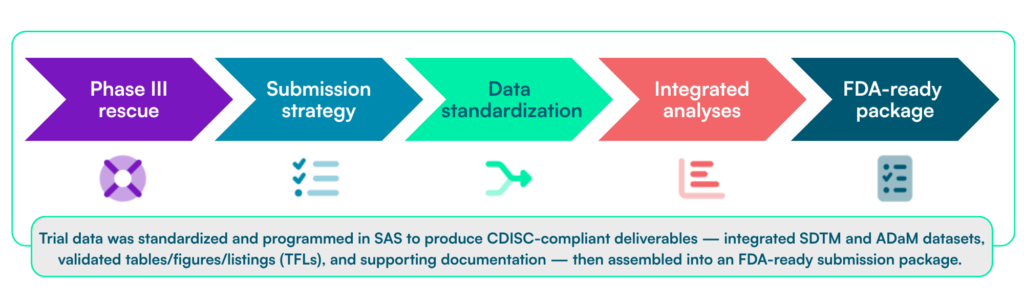
Datasets were converted into CDISC-compliant formats and assembled into pooled datasets supporting integrated analyses. The team generated validated tables, figures, and listings, and validated datasets and outputs against a predefined plan. Supporting documentation for regulatory review was prepared in parallel.
We enabled the client to align fragmented clinical data and deliver a submission-ready package within a compressed timeline.
Impact
Staying on track for a critical deadline
BC Platforms enabled the client to deliver its BLA within a compressed timeline, preserving a key regulatory milestone for its first product. The submission was completed four months after database lock and has since been accepted for review by the FDA, with the program now in regulatory review.
Stabilizing a high-risk situation
At a late stage in the program, delays and project delivery concerns had created significant uncertainty around the pivotal study and the broader submission. By taking over critical activities and re-establishing a clear execution path, our consultants helped restore the client’s ability to deliver the required analyses and datasets in line with submission timelines and quality expectations.
Moving from fragmented data to a cohesive regulatory asset
The program moved from a collection of heterogeneous datasets and inconsistent outputs to a fully structured, validated, and submission-ready package. This enabled our client to present data in a way that was both scientifically robust and aligned with regulatory expectations.
Enabling progress across regions
Beyond the FDA submission, the work set the foundation for the client’s ongoing regulatory interactions and future filings, including support for post-approval commitments in Europe.
Continued partnership beyond submission
Following submission, we continue to support the client during the FDA review process by producing additional analyses in response to agency questions. The team is also contributing to follow-on work related to European post-approval commitments, extending the collaboration beyond the initial filing.
Delivery metrics
We took data from 21 clinical trials, standardized it, and delivered the datasets, analyses, and outputs needed for a complete regulatory submission.
Output
Detail
SDSP
Covering 21 clinical studies
SDTM datasets
16 integrated datasets
ADaM datasets
7 integrated datasets
ISS outputs
SAP and TFLs
Phase III outputs
SAP, SDTM, ADaM, and TFLs
SDSP=Study Data Standardization Plan
SDTM=Study Data Tabulation Model
ADaM=Analysis Data Model
ISS=Integrated Summary of Safety
TFL=Tables, Figures and Listings
Why BC Platforms
BC Platforms was selected based on its ability to combine statistical, data, and regulatory expertise within a single delivery model, and to apply that capability across both integrated analyses and study-level execution.
Having already supported the broader submission program, the team brought established knowledge of the datasets, study designs, and regulatory requirements. This continuity enabled rapid takeover of Phase III delivery without disruption.
In a situation where data complexity, specialization, and timelines created significant delivery risk, BC Platforms provided the structure, expertise, and execution discipline required to keep the submission on track.
Conclusion
For this complex, multi-study submission in a highly specialized transplant indication, success depended on the ability to interpret heterogeneous data, align datasets across studies, and deliver validated outputs within a compressed timeline.
We enabled our client to consolidate clinical trial data, complete critical analyses, and deliver a submission-ready package aligned with regulatory requirements — supporting progression into FDA review and ongoing regulatory activities.
Preparing for an FDA submission?
Turn complex clinical trial data into submission-ready evidence with integrated datasets and regulatory-grade analyses.
Advancing early lung cancer detection with the Southampton Clinical Trials Unit
The iDx Lung study is accelerating early lung cancer detection through secure, harmonized real-world data analysis in collaboration with the Southampton Clinical Trials Unit.